

AI governance readiness requires more than an AI policy. Before scaling AI agents into production, enterprises need clear ownership, defined decision rights, scoped access to data and tools, proportionate human oversight, runtime monitoring, intervention mechanisms, and evidence of consequential actions. These AI governance guardrails help ensure that agents operate within defined boundaries as their responsibilities expand.
Most organizations do not have an AI policy problem. They have an authority problem.
As AI moves from generating recommendations to taking action, governance must answer a different set of questions: Who gave the agent authority? What is it allowed to do? What prevents it from doing more? And how quickly can its permissions be restricted if something goes wrong?
An agent can perform well in evaluation and still create unacceptable risk if it has broad data access, excessive tool permissions, or no meaningful way to intervene. AI governance for enterprises must therefore extend beyond model evaluation to the operational boundaries that determine what agents can access, decide, and execute across data, applications, tools, and workflows.
Ultimately, readiness means being able to define those boundaries, enforce them during operation, and demonstrate that they worked when it matters.
Key Takeaways
- Govern agent authority, not just model behavior.
- Define each agent’s business purpose, ownership, permitted actions, and boundaries before production.
- Apply least-privilege access to agent identities, data, applications, and tools.
- Match autonomy, approvals, and monitoring to the risk and potential impact of each action.
- Reassess permissions and controls when models, tools, data access, or operating conditions change.
- Maintain evidence that demonstrates what an agent did, which controls applied, and whether its actions were authorized.
AI Governance Readiness: From Policy to Operational Control
AI governance readiness is an organization’s ability to define, enforce, monitor, and demonstrate control over AI systems as they move into production. For AI agents, this means establishing not only what an agent is designed to do, but also what it is authorized to access, decide, and execute.
An effective AI governance framework connects business accountability, risk assessment, technical permissions, human oversight, runtime monitoring, and auditable evidence throughout the agent lifecycle. It must also account for shadow AI and establish consistent controls across internally developed agents, vendor solutions, and AI capabilities embedded in enterprise platforms.
The starting point is the agent’s mandate. Define the business outcome, assign accountable business and technical owners, and establish the minimum access and authority required to achieve the intended result. An IT operations agent may need to diagnose incidents and recommend remediation without being authorized to modify production infrastructure. Similarly, an agent may need to retrieve sensitive information without having permission to change it.
This distinction between technical capability and approved authority is the foundation of governed autonomy. The controls that follow translate that mandate into enforceable boundaries for identity, data access, tool permissions, human oversight, runtime intervention, and evidence.
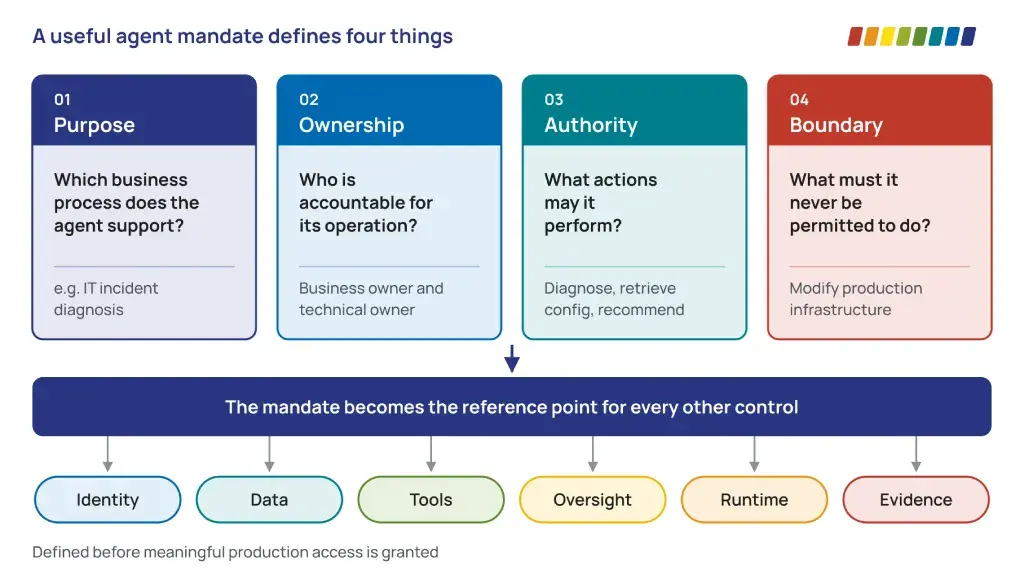
Purpose defines the business outcome, ownership establishes accountability, authority specifies permitted actions, and boundaries determine what the agent must not do.
Connecting the Controls: A Practical Governed Autonomy Model
Governed autonomy connects an agent’s business purpose and accountability to the technical controls that determine what it can access, decide, and execute. The model begins with four foundational elements: purpose, ownership, authority, and boundaries. Together, they guide identity management, data access, tool permissions, human oversight, runtime monitoring, intervention, and evidence.
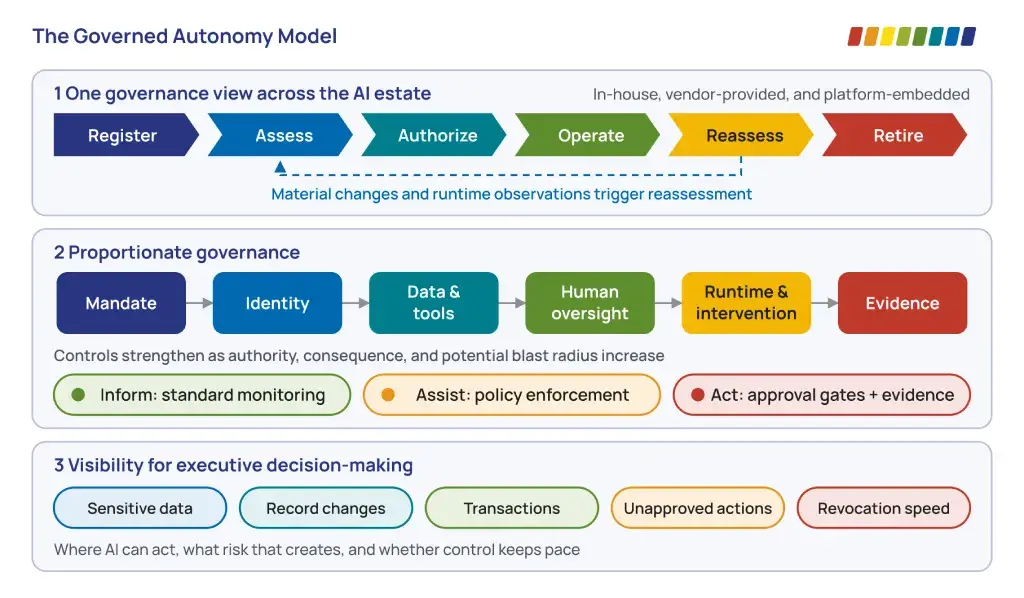
The Governed Autonomy Model: Four Foundational Elements
- Purpose: Define the business outcome the agent is intended to achieve and the scope of its responsibilities.
- Ownership: Assign accountable business and technical owners for decisions, implementation, and ongoing oversight.
- Authority: Specify the actions, data, tools, and systems the agent is permitted to access or use.
- Boundaries: Establish prohibited actions, approval requirements, and intervention mechanisms that constrain the agent’s autonomy.
Together, these elements keep the agent’s technical capabilities aligned with its approved business mandate.
Apply the Model Across the AI Lifecycle
Governance must remain effective throughout an agent’s lifecycle, from initial registration to retirement. As agents gain capabilities, connect to new systems, or take on additional responsibilities, their risk and control requirements may change.
- Register: Inventory the agent, document its purpose, and assign accountable owners.
- Assess: Classify risk and evaluate the agent’s permissions, autonomy, and potential impact.
- Authorize: Approve its mandate, access, permitted actions, and oversight requirements.
- Operate: Monitor behavior, enforce controls, and retain evidence of consequential actions.
- Reassess: Review changes to models, tools, permissions, data access, or business purpose.
- Retire: Revoke access and credentials, and preserve required records when the agent is decommissioned.
Enterprise-Wide Visibility
Enterprises need an inventory that covers internally developed agents, vendor solutions, AI capabilities embedded in enterprise platforms, and shadow AI. The inventory should capture ownership, purpose, risk classification, permissions, connected systems, lifecycle status, and relevant control requirements.
A consolidated governance view helps leaders identify unregistered agents, unclear accountability, excessive access, inconsistent controls, and unresolved exceptions. It also supports decisions about which agents are ready for production, which require remediation, and where additional autonomy can be justified.
The Core Controls for Governed AI Agents
Effective AI governance for AI agents requires controls across three areas: defining agent authority and permissions, managing autonomous actions and operational risk, and establishing evidence of governance effectiveness. Together, these areas help ensure that agents operate within approved boundaries and remain accountable as their responsibilities expand.
1. Define Agent Risk, Authority, and Permissions
Establish the Agent’s Mandate
Before expanding an agent’s production access, define the business process it supports, its accountable owner, its technical owner, and the actions it is authorized to perform. The mandate should distinguish between actions the agent can perform independently, actions requiring approval, and actions that are prohibited.
This creates a boundary between what an agent can do technically and what it is permitted to do operationally. In HR service delivery, governed AI requires appropriate access to employee information, defined action permissions, and clear approval and oversight requirements. Explore how these considerations apply to ServiceNow HR Service Delivery.
Give the Agent an Attributable Identity
Using a user’s permissions may simplify a pilot, but it can give an agent excessive access and make its actions difficult to distinguish from human activity.
In production, each agent should have its own attributable non-human identity, scoped permissions based on the principle of least privilege, clear ownership, and an audit trail. When acting on behalf of a user, the agent must operate within both the user’s access rights and its approved mandate.
A zero-trust approach reinforces these boundaries by authorizing access based on identity, context, and policy rather than implicit trust.
These controls help enterprises identify which agent acted, what permissions governed the action, and whether it operated within its approved authority.
Govern Data Access by Purpose
Agentic systems can determine what information they need at runtime and move that information across models, tools, applications, and workflows. Broad access therefore becomes difficult to justify simply because the agent technically has it.
Governance should establish what data the agent can access, why it needs that data, where the information can flow, and whether it can influence a consequential action. This is where AI governance and data governance increasingly converge.
The important question is not simply whether an agent can access a dataset. It is whether that access is necessary for the agent’s mandate and appropriately constrained for the action it is expected to perform.
Govern the Tools That Give Agents Authority
The model is only part of an agent’s risk profile. Connected tools determine what it can actually do, from retrieving information to modifying ERP records, changing production infrastructure, or initiating financial transactions.
Tool-level least privilege limits agents to the specific operations and resources required for their approved tasks. Each tool should have a defined purpose, access scope, credential, permitted operations, approval requirements, and revocation mechanism. Broad permissions and shared credentials used during development should not carry over into production.
2. Control Autonomous Actions and Operational Risk
Assess Risk by Operating Context
AI agent risk management should consider more than the underlying model. A useful assessment examines what the agent can access, what it can change, the consequences of an incorrect action, how far an error could propagate, and how difficult the result would be to reverse.
Two agents using the same foundation model may require very different controls. An agent answering questions from approved documentation presents a different risk from one modifying production infrastructure. The difference lies in the agent’s permissions, operational reach, and the potential consequences of its actions.
This assessment establishes the risk level that should determine the agent’s permitted autonomy, approval requirements, monitoring intensity, and intervention mechanisms.
Make Human Oversight Proportionate
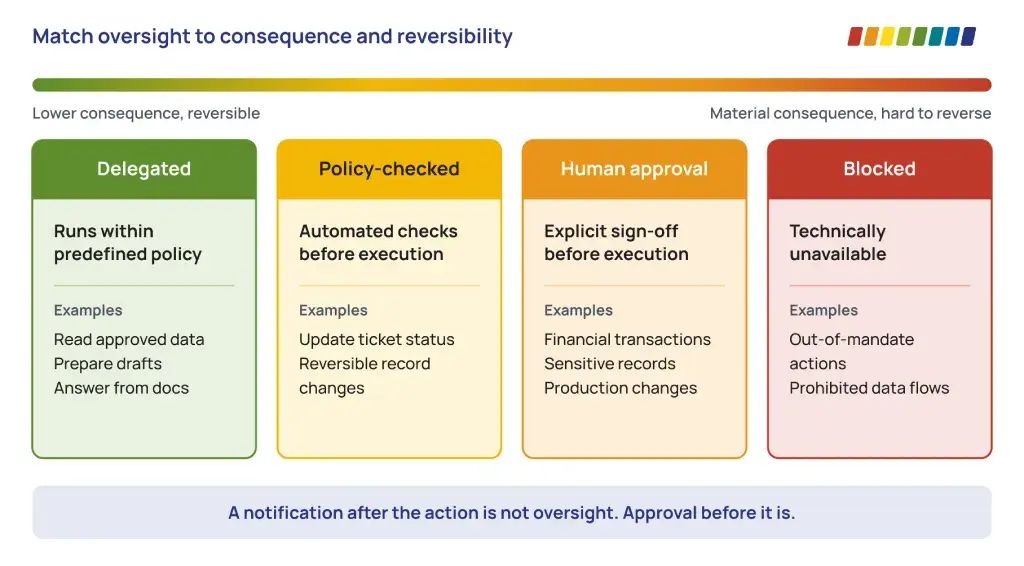
“Human in the loop” is not a sufficient control definition. Approval before an action is different from receiving a notification afterward, while requiring approval for every low-risk action can turn automation into a manual queue.
The level of oversight should reflect an agent’s autonomy, permissions, and potential impact. Low-risk tasks may proceed within approved boundaries, while actions involving sensitive data, financial transactions, or production systems may require explicit human approval, stronger monitoring, and tested intervention mechanisms. This approach preserves useful autonomy while keeping consequential actions under appropriate control.
The objective is not to insert a person into every step. It is to ensure that human judgment is applied where the consequences of autonomous action warrant it, with actions outside the agent’s permitted scope technically blocked.
Continue Governance at Runtime
Production approval does not freeze an agent’s risk profile. Changes to models, permissions, tools, APIs, and data sources can alter an agent’s capabilities and risks.
Runtime monitoring should detect unexpected access, tool calls, failed actions, and policy violations. Significant changes to models, permissions, connected tools, or data access should trigger reassessment.
When risk changes, organizations need to restrict tools, revoke credentials, suspend the agent, or limit it to read-only access. For high-impact scenarios, a kill switch or equivalent emergency shutdown mechanism can rapidly suspend execution during serious policy violations, security incidents, or unexpected behavior. This complements targeted responses such as disabling tools or restricting access.
These controls enable organizations to continuously monitor agent behavior, reassess risks, and adjust operating authority as conditions change.
3. Establish Evidence and Accountability
Build Evidence into the Lifecycle
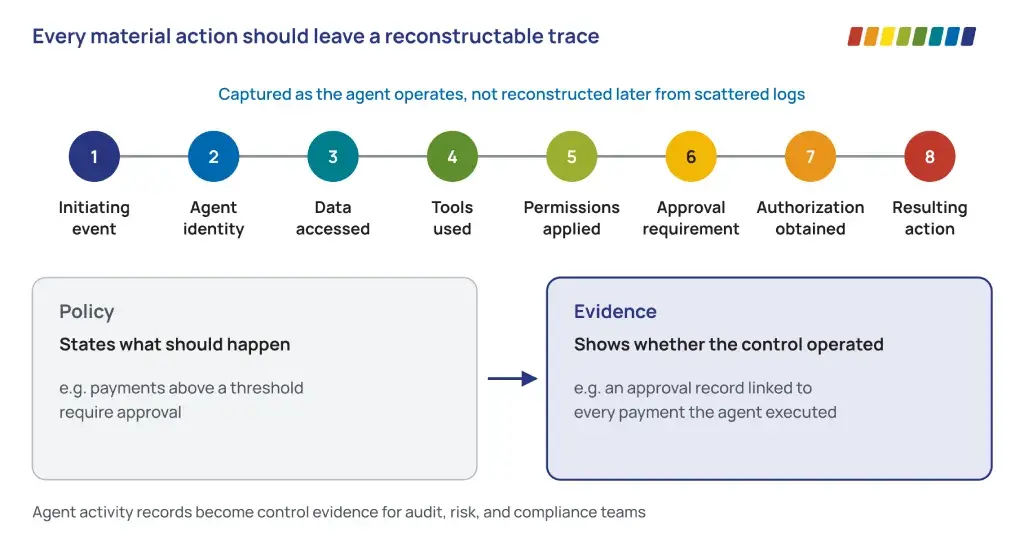
The evidence trace connects the agent’s identity, data access, tool usage, applied permissions, approval requirements, and actual authorization.
When an agent performs a material action, the organization should be able to reconstruct what happened. That includes the initiating event, agent identity, relevant data, tools used, permissions applied, approval requirements, actual authorization, and resulting action.
This turns agent activity records into control evidence rather than simply technical logs. A policy establishes what should happen; evidence demonstrates whether the control operated.
For higher-risk agents, this evidence also supports investigation, compliance reviews, incident response, and reassessment when the agent’s operating context changes.
Reassess Controls When Conditions Change
Governance evidence is valuable only when it supports decisions and corrective action.
Organizations should define reassessment triggers for material changes to an agent’s model, business purpose, permissions, connected tools, data access, or operating environment. Incidents, repeated policy exceptions, and monitoring findings may also warrant a review.
Reassessment should determine whether the existing mandate remains appropriate, whether controls continue to work, and whether the agent’s authority needs to be reduced, expanded, or suspended.
This closes the governance loop: define the mandate, enforce the controls, observe actual behavior, evaluate the evidence, and adjust authority when conditions change.
A Practical AI Governance Readiness Assessment
AI governance readiness depends on whether governance requirements translate into controls that operate effectively in practice. Use the following checklist to evaluate the current state of AI agent governance and identify areas requiring attention before expanding into production.
AI Governance Readiness Checklist
- Ownership: Is the agent’s business purpose documented, and are its business and technical owners accountable for its operation?
- Access: Are the agent’s identity, data access, system connections, and tool permissions limited to what its approved purpose requires?
- Authority: Are independent actions, actions requiring human approval, and prohibited actions clearly defined and enforced?
- Intervention: Can the organization detect inappropriate behavior and quickly restrict permissions, suspend the agent, or prevent further action?
- Evidence: Can the organization reconstruct material actions, including the agent identity, relevant permissions, approvals, and resulting changes?
If any answer is unclear, treat it as a governance gap to investigate before expanding the agent’s operational scope. These five questions provide an initial assessment, not a substitute for a detailed risk assessment or regulatory review.
An AI governance readiness assessment can examine these areas alongside agent inventory, risk classification, lifecycle management, exception handling, and incident response. The findings help organizations prioritize remediation and establish a practical roadmap for governed AI adoption.
Where to Start: A 30/60/90-Day AI Governance Roadmap
Organizations can begin operationalizing AI governance in 90 days by prioritizing high-risk agents, assigning accountability, and validating essential controls. The timeline depends on the size and complexity of the AI estate.
| Phase | Focus | Owners | Output |
|---|---|---|---|
| 01 · Days 1–30: Establish Visibility | Inventory AI agents, assign owners, and prioritize risks. | AI governance, business leads, IT | AI inventory and risk register |
| 02 · Days 31–60: Implement Controls | Define agent authority, restrict access, and establish approval requirements. | AI engineering, security, risk, business owners | Agent mandates and priority controls |
| 03 · Days 61–90: Validate and Scale | Test controls, verify monitoring and intervention, and plan wider rollout. | AI engineering, security, compliance, business owners | Validated controls and phased roadmap |
How Can Organizations Measure AI Governance Maturity?
AI governance maturity reflects how consistently an organization can establish, enforce, monitor, and demonstrate control over its AI systems. It is not measured simply by the number of policies written or agents deployed. The following four-level model provides a practical way to assess the current state and identify the next improvement priorities.
| Maturity level | Observable characteristics | Priority |
|---|---|---|
| 1. Ad hoc | Incomplete inventory, informal ownership, inconsistent permissions, limited monitoring, and fragmented evidence. | Establish visibility, assign owners, and address the highest-risk agents. |
| 2. Defined | Documented policies, risk classifications, approval requirements, and responsibilities, but inconsistent implementation across teams. | Standardize risk assessments, agent mandates, identity, and access controls. |
| 3. Operational | Controls are implemented in production, monitoring is active, actions are attributable, and intervention and reassessment procedures are established. | Test control effectiveness, strengthen evidence, and address recurring exceptions. |
| 4. Continuous | Governance spans the AI lifecycle, material changes trigger reassessment, and consolidated evidence informs ongoing risk and authorization decisions. | Measure control performance, improve consistency, and adapt governance as the AI estate evolves. |
Organizations should assess maturity across individual control areas, evaluating both control implementation and effectiveness. Key indicators include:
- Agents with accountable owners and documented mandates.
- Production agents with attributable identities and scoped permissions.
- Runtime monitoring and tested intervention coverage.
- Material actions supported by sufficient evidence.
- Time required to restrict or suspend an agent after a serious issue.
- Material changes and exceptions reviewed within defined timeframes.
Targets should reflect organizational risk and regulatory obligations. These measures help leaders track governance effectiveness as agent autonomy increases.
Mature AI governance enables enterprises to scale agent capabilities while maintaining control over what agents can access, decide, and execute.
Identify Your AI Governance Readiness Gaps
Before expanding AI agents into production, understand where your governance controls are strong, where gaps remain, and what needs attention first.
A focused AI governance readiness assessment can help evaluate your agent inventory, ownership, risk classification, access controls, oversight mechanisms, and evidence practices. Use the findings to prioritize remediation and establish a practical roadmap for scaling AI with greater control.
Free AI Governance Readiness Assessment
How ready are you to scale AI agents?
16 questions. 5 minutes. An instant report showing where you stand and what to fix first.
Your report includes
- 01A snapshot of your AI inventory
- 02A risk-tier view of your use cases
- 03Gaps against NIST AI RMF, ISO/IEC 42001, and the EU AI Act
- 04A prioritized 90-day roadmap
Organizations that need support translating governance requirements into operational controls can explore V-Soft’s Enterprise AI Governance Services, covering governance design, risk management, control implementation, and ongoing oversight.
Frequently Asked Questions