

AI in healthcare can improve clinical and operational efficiency by reducing manual effort in documentation, prior authorization, claims processing, capacity planning, and patient follow-up. The greatest value comes when these tools address clearly defined operational problems and produce measurable improvements.
Many health systems are not short of AI pilots. They are short of pilots that change how work gets done in a busy clinic on an ordinary afternoon.
This article explores how you can use data and AI to improve clinical and operational efficiency, what you need to scale these capabilities, and how to turn individual initiatives into measurable business outcomes.
Key Takeaways
- The biggest efficiency gains often come from reducing administrative work around patient care while keeping clinical decisions under appropriate human oversight.
- Inaccurate or disconnected data quietly creates rework for care teams, which makes data quality an operational issue rather than just an IT one.
- CMS-0057-F is accelerating electronic prior authorization through defined decision timeframes and upcoming FHIR-based API requirements for impacted payers.
- Strong data, integration, and governance foundations matter more to AI outcomes than the choice of AI tool.
- Organizations that prove value in one workflow and earn clinician trust scale AI faster than those that launch broad programs.
Where Healthcare Organizations Lose Time
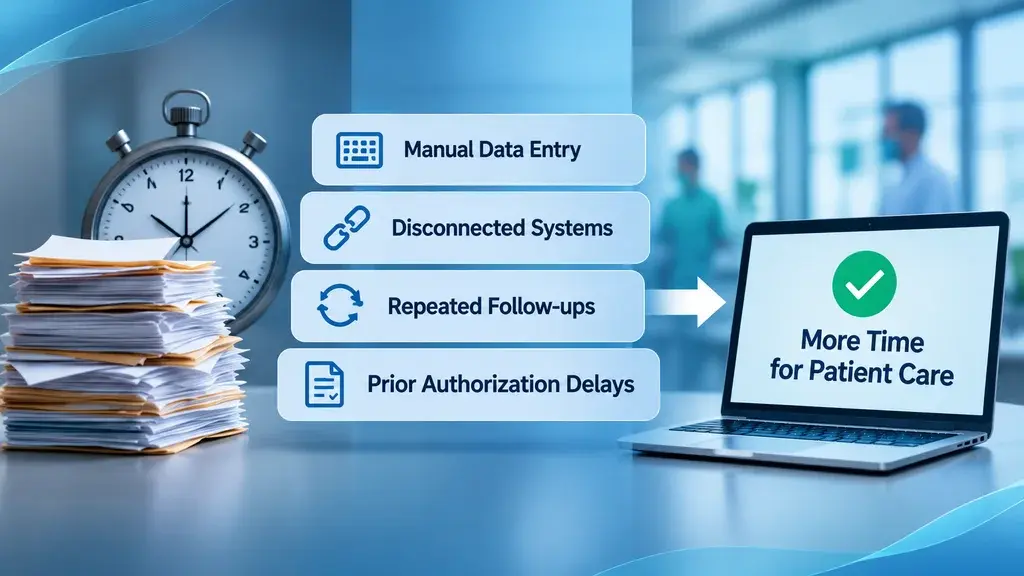
Healthcare organizations lose valuable time when clinical and administrative workflows depend on manual data entry, disconnected systems, and repeated follow-ups. Prior authorization, claims processing, and patient information exchange are common sources of delays. You can improve these processes with accurate data, connected systems, and automation that reduces administrative work while maintaining necessary human oversight.
Prior authorization illustrates how administrative complexity can affect both efficiency and patient care. According to the American Medical Association’s 2025 survey of physicians, respondents completed an average of 40 prior authorizations per physician each week, consuming approximately 13 hours of physician and staff time. The survey also found that 95% of respondents said prior authorization delays access to necessary care.
Regulatory changes are also accelerating the shift toward electronic prior authorization. Under CMS-0057-F, the Centers for Medicare & Medicaid Services (CMS) requires impacted payers, including Medicare Advantage organizations and Medicaid and CHIP programs, to respond to expedited prior authorization requests within 72 hours and standard requests within seven calendar days for covered medical items and services, excluding drugs.
These decision-timeframe requirements began on January 1, 2026. The rule also establishes FHIR-based API requirements, with implementation generally beginning January 1, 2027, subject to payer-specific compliance dates.
These figures and rules highlight an operational challenge that technology alone cannot solve. When payer requirements are difficult to navigate, information is fragmented, or authorization processes rely on manual follow-ups, healthcare teams spend valuable time resolving administrative issues.
Healthcare AI Use Cases That Improve Clinical and Operational Efficiency
AI can improve your healthcare workflows by reducing repetitive work across clinical and administrative activities. Common applications include clinical documentation, prior authorization, claims processing, medication management, capacity planning, and patient engagement.
The greatest benefits come when you apply AI to specific operational challenges and integrate it into existing systems and workflows.
1. Clinical documentation with ambient AI scribes
Ambient AI scribes draft clinical notes from patient conversations, helping clinicians reduce documentation time and access information more efficiently.
A 2025 JAMA Network Open study involving 263 clinicians across six U.S. health systems found that the share of clinicians reporting burnout fell from 51.9% to 38.8% after 30 days of ambient AI scribe use.
While promising, the findings should be interpreted with caution. The study used a pre-post design without a control group and followed clinicians for 30 days. Several authors also disclosed relationships with the AI scribe vendor, which should be considered when interpreting the results.
Effective implementation still requires clinical review, privacy safeguards, and integration into existing workflows.
2. Prior authorization, claims, and revenue workflows
AI can help healthcare teams verify payer requirements, prepare supporting documents, and identify missing information before submitting authorization requests or claims. Effective automation, however, depends on accurate data and connected systems.
For example, AI-powered claims workflows can validate submitted information, identify missing details, and flag potentially suspicious claims for further review. V-Soft’s Generative AI Medical Assistants case study highlights how AI-powered claim validation and fraud detection can help reduce financial risk in insurance claims.
As electronic prior authorization expands, strengthen your data and integration capabilities to reduce manual work and streamline approval processes.
3. Medication and prescription workflows
E-prescribing depends on accurate prescription history, formulary, and benefit data. Connecting these sources and cleaning the data can reduce pharmacy callbacks, duplicate entry, and authorization issues at the point of prescribing.
For example, an AI-supported workflow can flag missing prescription information or identify a potential mismatch between a prescribed medication and available formulary data for review by the care team.
4. Operational visibility and capacity planning
Unified data platforms replace manually compiled reports with near-real-time views of patient volumes, staffing, throughput, and backlogs. Predictive models can then help leaders adjust schedules and capacity before bottlenecks form.
For example, you can use historical appointment volumes and current staffing data to identify departments likely to experience scheduling pressure and plan resources accordingly.
5. Patient engagement between visits
For chronic conditions, you can use data-driven outreach and AI-assisted coaching to personalize reminders and follow-ups at scale. These workflows can also route patient concerns and exceptions back to clinicians for review.
For example, personalized digital coaching can help patients with chronic conditions stay engaged between appointments through tailored reminders, progress updates, and follow-up support. V-Soft’s Generative AI Medical Assistants case study highlights how personalized digital coaching can support patient engagement in chronic care.
What Do You Need to Scale AI in Healthcare?
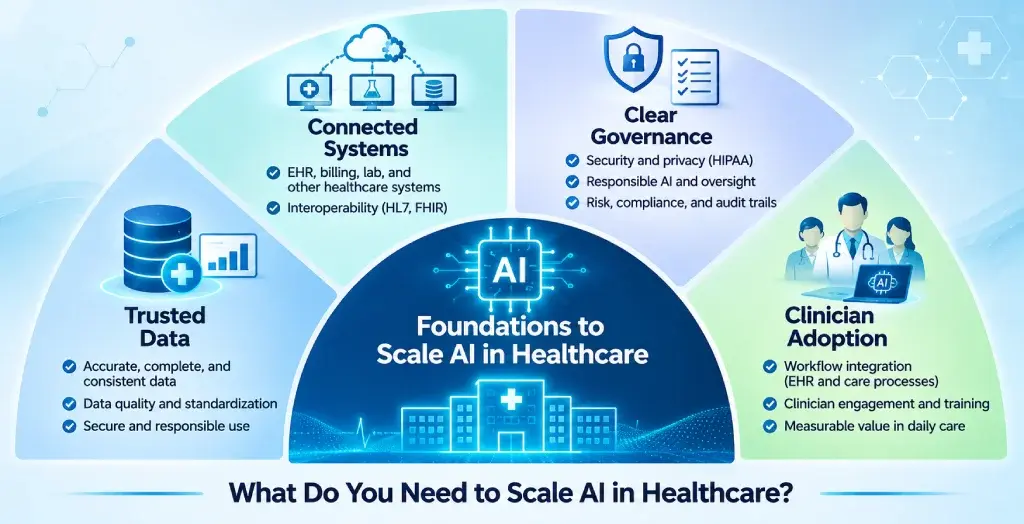
You need four foundations to scale AI successfully in healthcare: trusted data, connected systems, clear governance, and clinician adoption. These foundations ensure your AI tools work with reliable information, fit existing processes, protect sensitive data, and deliver measurable improvements beyond an initial pilot.
A successful AI pilot does not automatically translate into organization-wide efficiency. A documentation assistant may save time for individual clinicians, for example, but the overall benefit can be limited if the resulting notes still require duplicate entry, disconnected approvals, or manual reporting.
Sustainable improvement comes from examining the complete workflow, identifying where delays and rework occur, and addressing the underlying process and data gaps alongside the technology.
Four prerequisites determine whether an AI pilot can scale:
- Trusted data: Ensure your patient, prescription, and claims data is accurate, consistent, and governed. AI built on poor-quality records simply automates existing errors.
- Connected systems: Establish reliable integrations and standard APIs across your electronic health record (EHR), pharmacy, laboratory, billing, and payer systems to reduce manual data entry.
- Clear governance: Define privacy safeguards, HIPAA compliance requirements, model validation, bias monitoring, and human review before deployment, especially when AI informs clinical decisions.
- Clinician adoption: Make sure your tools fit existing clinical and administrative workflows. Involve clinicians and staff early, and redesign processes where needed instead of adding another screen.
How Can You Move Healthcare AI from Pilot to Measurable Results?
You should select a high-volume workflow, establish baseline performance, address data and integration gaps, run a controlled pilot, and expand only when the results demonstrate meaningful operational improvements.
Treat AI as an operating change with a business case, not a technology trial. Here is a practical sequence:
- Pick one costly, high-volume workflow, such as prior authorization for one specialty or documentation in one clinic.
- Measure the baseline first: hours spent, turnaround time, denial or rework rate, and after-hours charting.
- Fix the data and integrations that workflow depends on.
- Run a time-boxed pilot with defined review and escalation rules.
- Scale only what moves the baseline, then reuse the same data foundation for the next use case.
Not sure which healthcare workflow to automate first?
Talk to V-Soft’s healthcare data team to identify the right starting point, assess your data and integration readiness, and build a practical roadmap from AI pilot to production.
Which Metrics Should You Track to Measure Healthcare AI Performance?
Measure healthcare AI performance using workflow-specific metrics such as documentation time, prior authorization turnaround, claim denial rates, staff productivity, and patient follow-up completion.
Balance these measures with quality indicators to ensure efficiency gains do not compromise accuracy, patient safety, or clinical oversight.
| Use case | Metrics to measure | Business outcome | Quality guardrail |
|---|---|---|---|
| Clinical documentation | Documentation time, after-hours charting, note correction rates | Lower administrative burden and improved clinician experience | Clinical note accuracy and clinician review rates |
| Prior authorization | Processing time, incomplete submissions, rework rates | Faster processing and fewer avoidable administrative delays | Authorization accuracy and appropriate clinical review |
| Claims processing | Clean claim rate, denial rate, manual review volume | More efficient revenue cycle operations | Claim accuracy and compliance with payer requirements |
| Capacity planning | Waiting times, resource utilization, scheduling gaps | Better use of staff and facilities | Staffing adequacy and patient access |
| Patient engagement | Follow-up completion, response rates, escalation rates | More consistent follow-up and better operational visibility | Appropriate escalation of clinical concerns and follow-up accuracy |
These metrics should be interpreted in context. For example, a reduction in processing time is useful only if authorization accuracy and clinical oversight are maintained. Maintaining this balance helps you distinguish genuine operational improvements from activity that has simply been automated.
How V-Soft Helps Your Healthcare Organization Implement AI
V-Soft helps you address healthcare operational challenges through healthcare data management, systems integration, AI, and workflow automation. By connecting the right data and technology capabilities to your business needs, you can improve workflow visibility, reduce repetitive work, and build a practical foundation for scaling AI.
V-Soft’s Generative AI Medical Assistants case study
shows how AI addressed challenges across clinical workflows, patient engagement, and financial operations for a healthcare provider.
The following results illustrate the reported impact across these use cases:
- 40% higher patient engagement through personalized digital coaching for chronic care.
- 40% efficiency gain in physician workflows, supporting productivity and patient care management.
- 60% reduction in financial risk from insurance claims through AI-powered claim validation and fraud detection.
- 90% reduction in reporting time, helping accelerate clinical decision-making.
These results demonstrate how targeted AI applications can address specific healthcare challenges and deliver measurable improvements when supported by relevant data and clearly defined operational goals.
V-Soft’s relevant capabilities include:
- Healthcare data management and analytics: Improve data reliability, reporting, and access to insights teams can act on through V-Soft’s data and analytics services.
- Healthcare systems integration: Connect your EHR, laboratory, billing, and other healthcare systems to support consistent information exchange.
- AI and workflow automation: Identify opportunities to reduce repetitive work and improve operational processes through AI and automation.
- Healthcare operations: For the non-clinical work around care, use ServiceNow workflows to coordinate processes across healthcare teams, including service requests, approvals, and operational follow-ups. Integrating these workflows with relevant enterprise systems improves visibility and helps you manage requests more consistently.
Choose the combination of capabilities that align with your existing systems, data readiness, workflow challenges, and desired outcomes.
Ready to Turn Healthcare Data into Measurable Results?
V-Soft Consulting can help you choose the right first workflow, assess the data and integrations it depends on, and run a measurable pilot that builds the case for scaling.